
Please find our most recent market review below. We hope these perspectives are valuable to you.
– The AdvicePeriod Team
Key observations
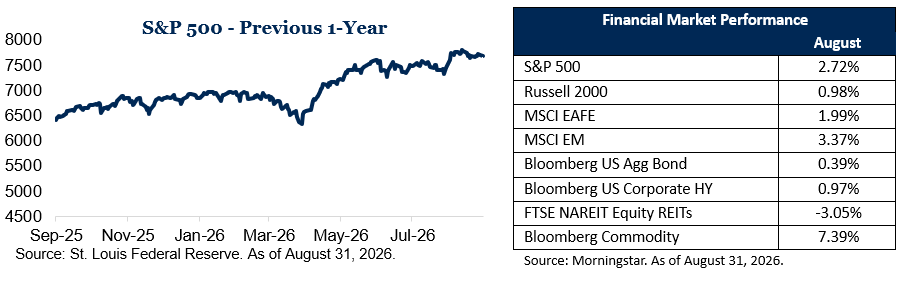
- Equities posted solid gains, with technology reclaiming leadership. The S&P 500 rose 2.7% in August and the Nasdaq gained 4.2%, while the Dow added 1.5% for its fifth straight positive month.
- Rate expectations reversed from cuts toward a possible hike. Fed Chair Kevin Warsh said at Jackson Hole on Aug. 28 that the summer’s better inflation readings did not show underlying trends had meaningfully improved, and traders lifted the odds of a September increase to roughly 60% by month-end.
- Hiring stalled while inflation held above target. Payrolls fell by 23,000 in July with prior months revised down by a combined 103,000, and Core Personal Consumption Expenditures (PCE) has now held at 3.3% or 3.4% for four consecutive months.
August was a month in which markets and the incoming economic data pointed in different directions. Stocks advanced and technology resumed its leadership, while the labor and inflation reports released during the month described an economy that is still growing but hiring less and making little further progress toward the Federal Reserve’s 2% target. A late-month speech from the Fed chair then reset expectations for policy in a direction few investors had positioned for at the start of the summer. Below we review each of these developments.
Equity markets advanced, with technology back in front
U.S. stocks gained ground in August despite a number of competing pressures. The S&P 500 rose 2.7% for the month and the Nasdaq gained 4.2%, while the Dow Jones Industrial Average added 1.5% and recorded its fifth consecutive positive month. The S&P 500 reached an all-time high early in August, drifted lower over the balance of the month, and still finished ahead of its July close. Small caps lagged, with the Russell 2000 up 1%, though it remains the strongest of the major domestic benchmarks year to date at roughly 20%.
Sector results were mixed rather than uniformly positive. Financials, information technology, health care, materials, communication services and consumer discretionary all gained ground, while utilities, industrials, real estate and consumer staples declined. The pattern marks a shift from the first half of the year, when leadership had broadened toward smaller and more cyclical parts of the market. In August, investors returned to the largest technology and artificial intelligence (AI)-linked businesses, and the concentration of returns narrowed accordingly.
International markets were similarly positive. The developed markets-focused MSCI EAFE index was up 2% for the month while the Emerging Markets index was up 3.4%. Fixed income also finished in positive territory, with the Bloomberg US Aggregate Bond Index up 0.39% and high yield up 0.97%. The 10-year Treasury ended August at 4.75%, little changed on the month though roughly 59 basis points higher than where it began the year. Crude oil rose about 2% to close near $86 per barrel, and gold gained over 9% to end August around $4,437 per ounce.
The Fed turned more hawkish at Jackson Hole
The Federal Open Market Committee (FOMC) did not meet in August, leaving the federal funds target range at 3.50% to 3.75%. The more consequential development came at the annual Jackson Hole symposium on Aug. 28, where Chair Kevin Warsh delivered his first address in that role. Warsh said he was impressed by the economy’s overall performance but expressed concern that underlying inflation trends had not meaningfully improved, and he indicated rates could need to move higher if more progress is not made on prices.
Markets repriced quickly. Ahead of the speech, futures implied roughly a one-in-three chance of a September increase; immediately afterward that probability rose to about 56%, some 20 percentage points higher than the prior day. By Aug. 31, the implied odds had climbed to roughly 60%. Deutsche Bank maintained its expectation for 50 basis points of tightening this year, with increases at the September and December meetings, while others were more skeptical, noting that the July FOMC meeting produced no consensus to raise rates and that the data released since have shown both cooler inflation and softer hiring. The Committee next meets on Sept. 16.
Hiring stalled while inflation held above target
The employment report released Aug. 7 covered July and was weaker than expected. Nonfarm payrolls declined by 23,000 against consensus estimates in the 83,000 to 95,000 range, and revisions reduced May by 66,000 and June by 37,000, bringing the average monthly gain over the prior twelve months to roughly 34,000. The unemployment rate ticked down to 4.1%, but the improvement reflected people leaving the workforce: participation fell to 61.4%, its lowest in more than five years. Twelve-month wage growth slowed to 3.2%, the weakest pace since May 2021. ADP’s more current read showed private employers adding 38,000 jobs in August, the slowest month since January, with gains concentrated in education and health services while manufacturing shed 17,000 positions.
Inflation data released during August were more encouraging at the headline level. July CPI, published August 12, rose 0.1% for the month and 3.4% over the prior year, down from 3.5% in June, with core CPI at 2.5% annually. Shelter accounted for roughly two-thirds of the monthly increase, and energy prices fell 1.5% for the month even as they remained close to 15% higher than a year earlier.
The Fed’s preferred gauge told a less settled story. The July PCE price index, released Aug. 26, rose 3.7% from a year earlier, a tenth above consensus, with core PCE at 3.3%. That core reading has now held at 3.3% or 3.4% in each of the last four months, indicating progress on underlying inflation has largely stalled.
Broader activity held up. The second estimate of second-quarter GDP, also released August 26, held at a 1.5% annualized rate, down from 2.1% in the first quarter, though consumer spending within it was revised up to 3.4% and corporate profits increased $400.9 billion. Business surveys covering August stayed in expansion, with the ISM Manufacturing PMI at 54.6% and ISM Services at 55.4%. Households were less sanguine: the Conference Board’s Consumer Confidence Index slipped to 89.4 in August from 90.2, and the University of Michigan’s sentiment index fell to 51.7, about 6% below July, with year-ahead inflation expectations at 4.0%.
Putting the month in context
One policy development outside the data calendar is worth noting. Trade negotiations between the United States and Canada broke down in late August, and the administration began enforcing 50% tariffs on roughly $20 billion of Canadian goods on Aug. 22, with Canada announcing matching measures to take effect Sept. 8. National average gasoline prices stayed above $4 per gallon throughout the month.
Taken together, August described an economy that is still expanding, supported by consumer spending and corporate profitability, but one in which job creation has stopped and inflation has settled meaningfully above the Fed’s target. Equity markets looked past that combination and focused on earnings and the AI investment cycle. Bond markets did not, and the repricing that followed Jackson Hole left investors weighing the possibility of tighter policy for the first time in this cycle rather than easier policy.
Two releases in the coming days will do a good deal to clarify which reading is closer to right: the August employment report on Sept. 4 and the August Consumer Price Index on Sept. 11, both of which the FOMC will have in hand before it meets on Sept. 16. We will continue to monitor these developments and keep you informed.
Thank you for your continued trust.
This market commentary is meant for informational and educational purposes only and does not consider any individual personal considerations. As such, the information contained herein is not intended to be personal investment advice or a recommendation of any kind. The commentary represents an assessment of the market environment through August 2026.
The views and opinions expressed may change based on the market or other conditions. The forward-looking statements are based on certain assumptions, but there can be no assurance that forward-looking statements will materialize.
Equity securities are subject to price fluctuation and investments made in small and mid-cap companies generally involve a higher degree of risk and volatility than investments in large-cap companies. International securities are generally subject to increased risks, including currency fluctuations and social, economic, and political uncertainties, which could increase volatility. These risks are magnified in emerging markets.
Fixed-income securities are subject to loss of principal during periods of rising interest rates and are subject to various other risks including changes in credit quality, market valuations, liquidity, prepayments, early redemption, corporate events, tax ramifications, and other factors before investing. Interest rates and bond prices tend to move in opposite directions. When interest rates fall, bond prices typically rise, and conversely, when interest rates rise, bond prices typically fall.
There is no assurance that any investment, plan, or strategy will be successful. Investing involves risk, including the possible loss of principal. Past performance does not guarantee future results, and nothing herein should be interpreted as an indication of future performance. Please consult your financial professional before making any investment or financial decisions.
AdvicePeriod is another business name and brand utilized by both Mariner, LLC and Mariner Platform Solutions, LLC, each of which is an SEC registered investment adviser. Registration of an investment adviser does not imply a certain level of skill or training. For additional information about Mariner, LLC or Mariner Platform Solutions, LLC, including fees and services, please contact us utilizing the contact information provided herein or refer to the Investment Adviser Public Disclosure website.
For additional information as to which entity your adviser is registered as an investment adviser representative, please refer to the Investment Adviser Public Disclosure website or the Form ADV 2B provided to you. Investment adviser representatives of Mariner, LLC are generally employees. Investment adviser representatives of Mariner Platform Solutions, LLC dba AdvicePeriod, are independent contractors.
Indexes referenced are unmanaged and cannot be directly invested into. For index definitions visit https://www.marinerwealthadvisors.com/index-definitions/
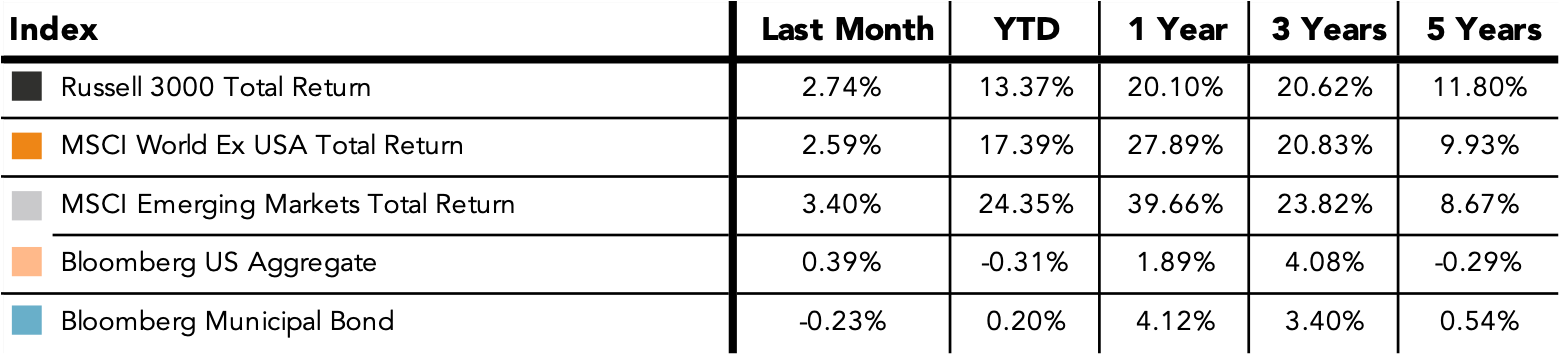
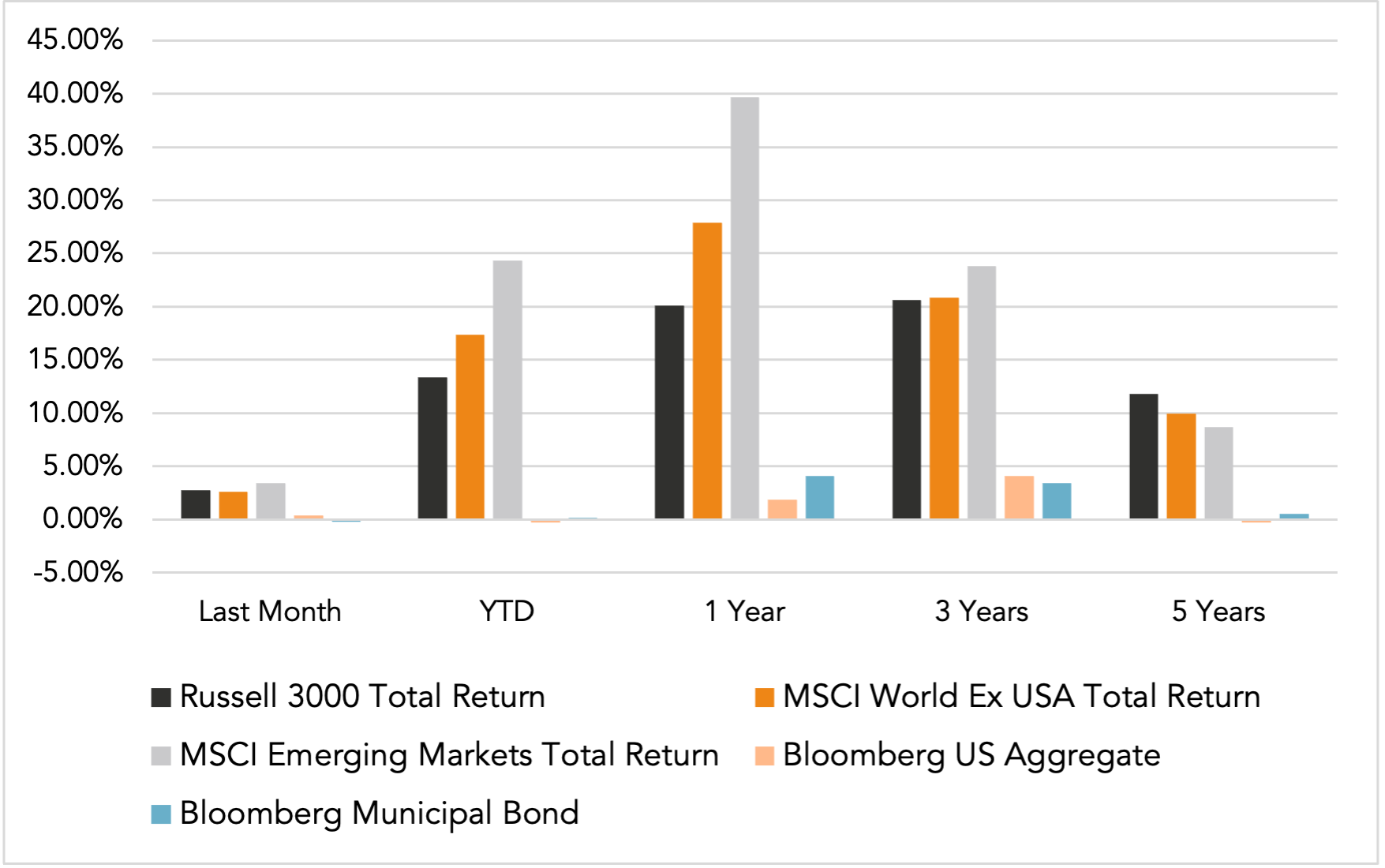
Does past performance matter?
Major Market Index Returns
Period Ending 8/1/2026
Multi-year returns are annualized.
Mix Index Returns
Global Equity / US Taxable Bonds
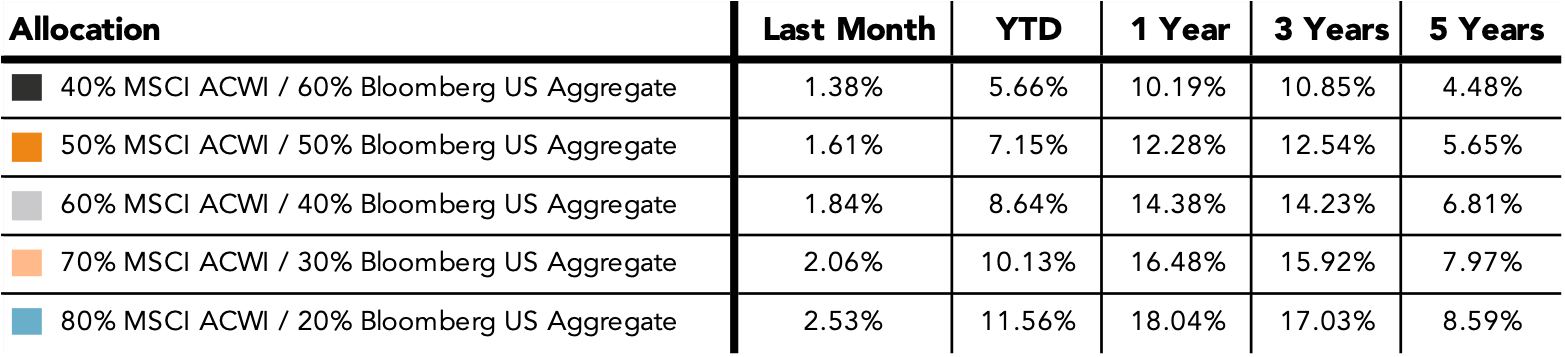
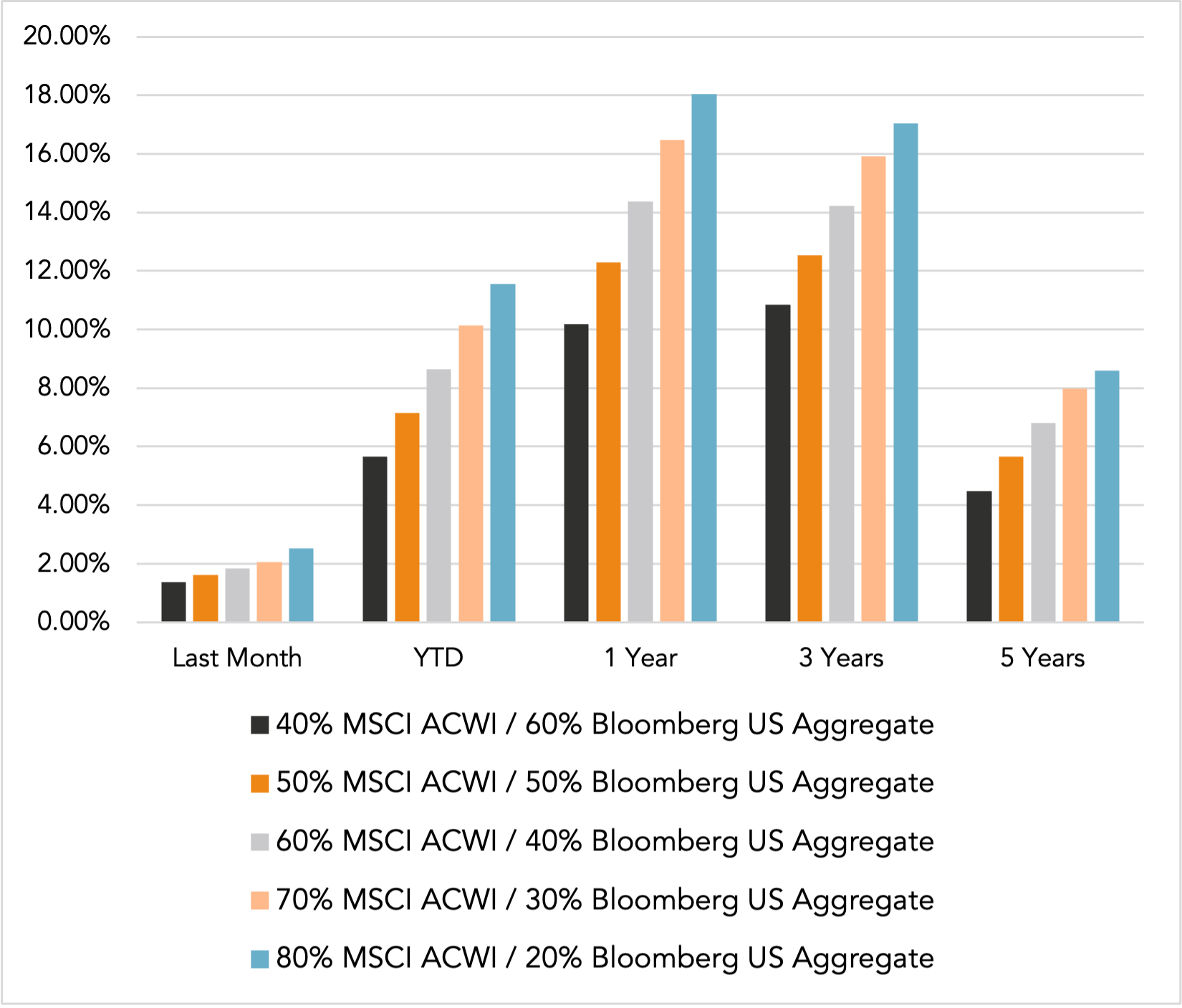
Indexes are unmanaged and cannot be directly invested into. Past performance is no indication of future results. Investing involves risk and the potential to lose principal.
The Russell 3000 Index is a United States market index that tracks the 3000 largest companies. MSCI Emerging Markets Index is a broad market cap-weighted Index showing the performance of equities across 23 emerging market countries defined as emerging markets by MSCI. MSCI ACWI ex-U.S. Index is a free-float adjusted market capitalization-weighted index that is designed to measure the equity market performance of developed and emerging markets excluding companies based in the United States. Bloomberg U.S. Aggregate Bond Index represents the investment-grade, U.S. dollar-denominated, fixed-rate taxable bond market, including Treasuries, government-related and corporate securities, as well as mortgage and asset-backed securities. Bloomberg Municipal Index is the US Municipal Index that covers the US dollar-denominated long-term tax-exempt bond market. The index has four main sectors: state and local general obligation bonds, revenue bonds, insured bonds, and prerefunded bonds.


Monthly Market Update – July 2026