
Please find our most recent market review below. We hope these perspectives are valuable to you.
– The AdvicePeriod Team
Key observations
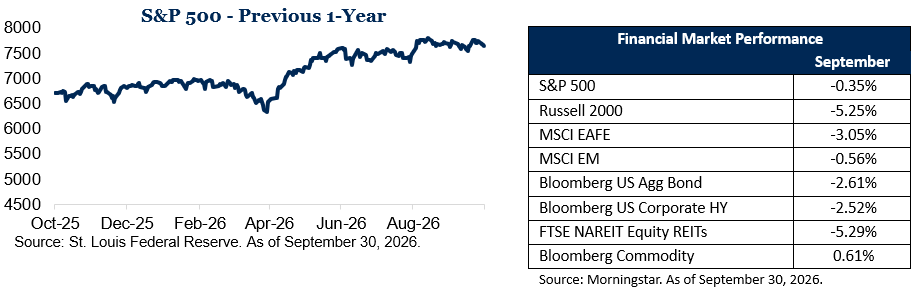
- Major stock market indices had mixed performance during the month, with the S&P 500 falling 0.35 %, the Dow down 4.12% and the Nasdaq rising 1.93%.
- Investors reacted to rising interest rates and the first Fed rate hike since July 2023, as the central bank tries to rein in stubbornly high inflation.
- The tech-heavy Nasdaq Composite was the only major index to see gains during September, as investor optimism around artificial intelligence drove shares higher. The small-cap Russell 2000 index fell 5.25% during the month.
The bond market took center stage during September, as stubbornly high inflation and higher energy prices led to the first rate hike by the Federal Reserve in over three years. The rise in interest rates sent bonds and stocks (mostly) lower, with cyclical companies and those more sensitive to rising rates experiencing the most severe declines. The Nasdaq was able to buck that trend, as the artificial intelligence (AI) boom continued to push shares of tech stocks higher. More on these key market drivers below.
AI drives tech stocks higher, despite rising rates
On Sept. 16, the Fed increased the federal funds target range by a quarter point to 3.75% to 4.0% in an effort to combat high inflation. In response, equity markets saw a significant divergence in their performance during the month, as investors grappled with how higher interest rates would impact different sectors of the economy. Interest rates ended the month at their highest levels in about 20 years.
Higher interest rates can impact how investors think about stocks in a few ways. First, they increase the discount rate investors apply to future cash flows that companies generate, which lowers their value today, all else being equal. Second, companies that rely on debt for financing may be forced to pay higher borrowing costs, which reduces the earnings available to equity shareholders.
This helps to explain the performance of major equity indices during September. The Russell 2000, which is comprised of smaller companies that tend to be more cyclical and rely more on debt for financing needs, fell more than 5%. On the other hand, the Nasdaq Composite, which is largely driven by well-capitalized, high-growth tech companies, saw gains of nearly 2%.
The wide performance gap between major indices shows the benefits of holding a diversified portfolio. Large tech companies performed best this month, but that could change under different economic circumstances. Owning a diversified portfolio generally means you should have some investments that are performing better than others.
International stocks also fell, with the developed markets-focused MSCI EAFE index down more than 3% and the Emerging Markets index down 0.56%. The Bloomberg US Aggregate Bond Index and high yield index each fell more than 2.5%. The 10-year Treasury ended September at 5.29%, up from 4.75% at the end of August.
Fed hikes rates for first time since 2023
The Federal Open Market Committee (FOMC) voted to raise the federal funds target range by a quarter point to 3.75% to 4% in September, the first policy move under new Fed Chair Kevin Warsh. The move did not come as a surprise after Warsh’s hawkish comments in August at the Jackson Hole symposium. In its statement, the FOMC said the rate hike would support a “timelier return” to its inflation target of 2%.
In general, economic conditions continue to be strong, driven by strong consumer spending, huge investments to support the AI infrastructure buildout and a steady jobs market. The September jobs report, released in early October, showed low levels of hiring, which markets welcomed in the hope that it might mean the Fed won’t raise rates again in October. The FOMC’s next announcement will come on October 28.
Putting the month in context
September was another month of economic growth, but rising energy prices, sticky inflation and a Fed rate hike bring uncertainty to the current outlook. Higher interest rates can be a restriction on economic activity and areas such as housing and autos are feeling the pain. Bond prices, which move in the opposite direction of interest rates, have also fallen.
Meanwhile, the tech sector continues to benefit from massive AI spending, which is expected to drive the third consecutive quarter of more than 20% earnings growth at S&P 500 companies.
The U.S. added 29,000 jobs in September, which fell short of expectations, but the unemployment rate remains low at 4.2%. The report was the final one before voters head to the polls on Nov. 3 for the midterm elections.
Looking ahead to October
October brings the start of corporate earnings season, which will give investors their first look at companies’ third-quarter earnings. The latest read on inflation will come on Oct. 14, which could impact the Fed’s thinking on future rate hikes. We will continue to monitor these and other developments and keep you informed.
Thank you for your continued trust.
This market commentary is meant for informational and educational purposes only and does not consider any individual personal considerations. As such, the information contained herein is not intended to be personal investment advice or a recommendation of any kind. The commentary represents an assessment of the market environment through August 2026.
The views and opinions expressed may change based on the market or other conditions. The forward-looking statements are based on certain assumptions, but there can be no assurance that forward-looking statements will materialize.
Equity securities are subject to price fluctuation and investments made in small and mid-cap companies generally involve a higher degree of risk and volatility than investments in large-cap companies. International securities are generally subject to increased risks, including currency fluctuations and social, economic, and political uncertainties, which could increase volatility. These risks are magnified in emerging markets.
Fixed-income securities are subject to loss of principal during periods of rising interest rates and are subject to various other risks including changes in credit quality, market valuations, liquidity, prepayments, early redemption, corporate events, tax ramifications, and other factors before investing. Interest rates and bond prices tend to move in opposite directions. When interest rates fall, bond prices typically rise, and conversely, when interest rates rise, bond prices typically fall.
There is no assurance that any investment, plan, or strategy will be successful. Investing involves risk, including the possible loss of principal. Past performance does not guarantee future results, and nothing herein should be interpreted as an indication of future performance. Please consult your financial professional before making any investment or financial decisions.
AdvicePeriod is another business name and brand utilized by both Mariner, LLC and Mariner Platform Solutions, LLC, each of which is an SEC registered investment adviser. Registration of an investment adviser does not imply a certain level of skill or training. For additional information about Mariner, LLC or Mariner Platform Solutions, LLC, including fees and services, please contact us utilizing the contact information provided herein or refer to the Investment Adviser Public Disclosure website.
For additional information as to which entity your adviser is registered as an investment adviser representative, please refer to the Investment Adviser Public Disclosure website or the Form ADV 2B provided to you. Investment adviser representatives of Mariner, LLC are generally employees. Investment adviser representatives of Mariner Platform Solutions, LLC dba AdvicePeriod, are independent contractors.
Indexes referenced are unmanaged and cannot be directly invested into. For index definitions visit https://www.marinerwealthadvisors.com/index-definitions/
Does past performance matter?
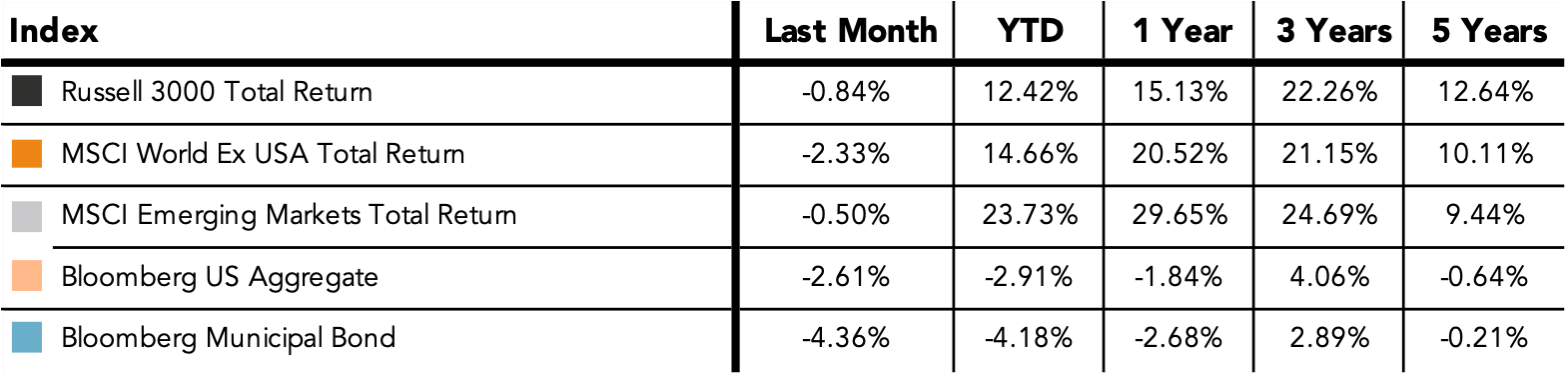
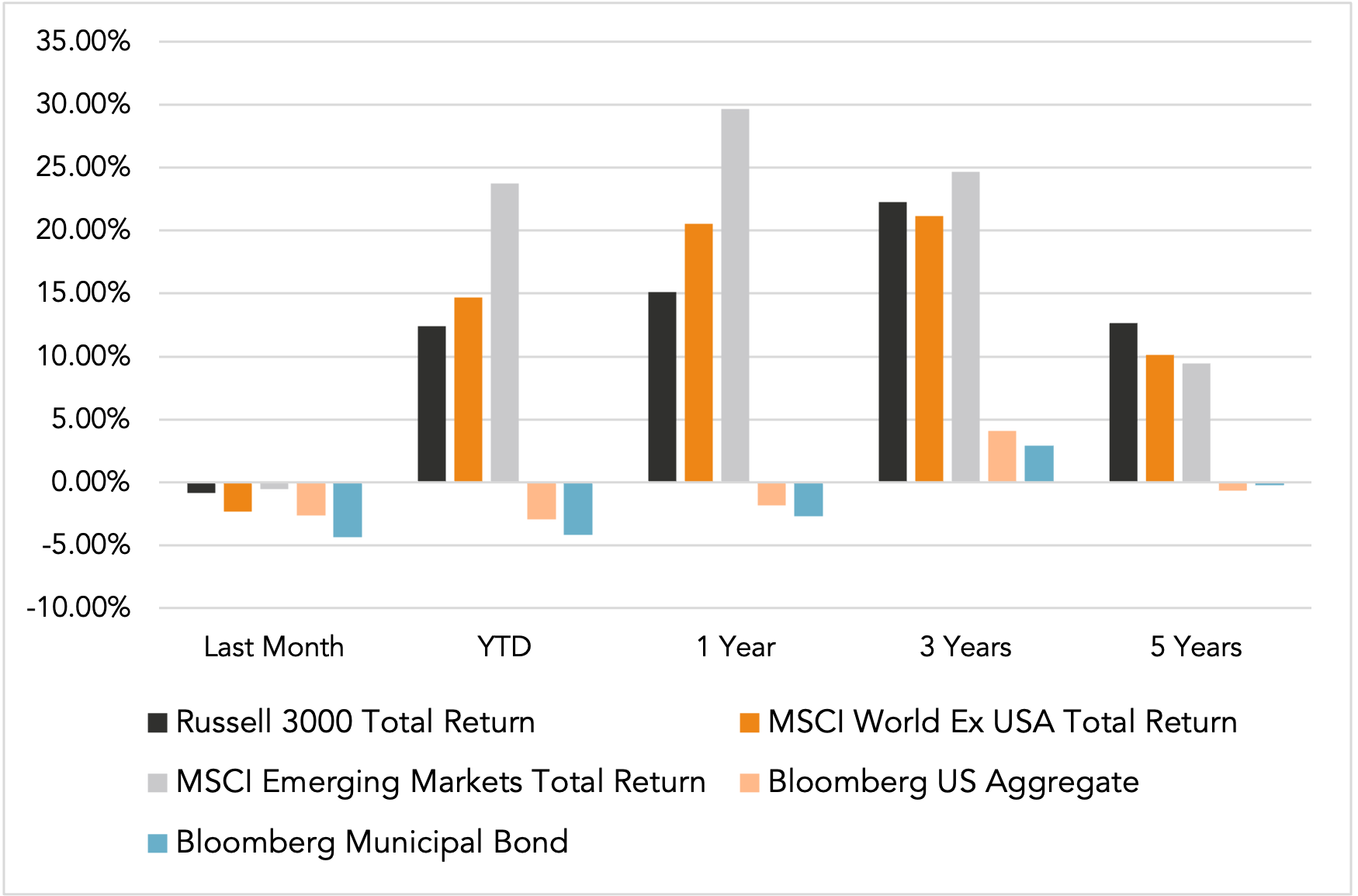
Major Market Index Returns
Period Ending 9/1/2026
Multi-year returns are annualized.
Mix Index Returns
Global Equity / US Taxable Bonds
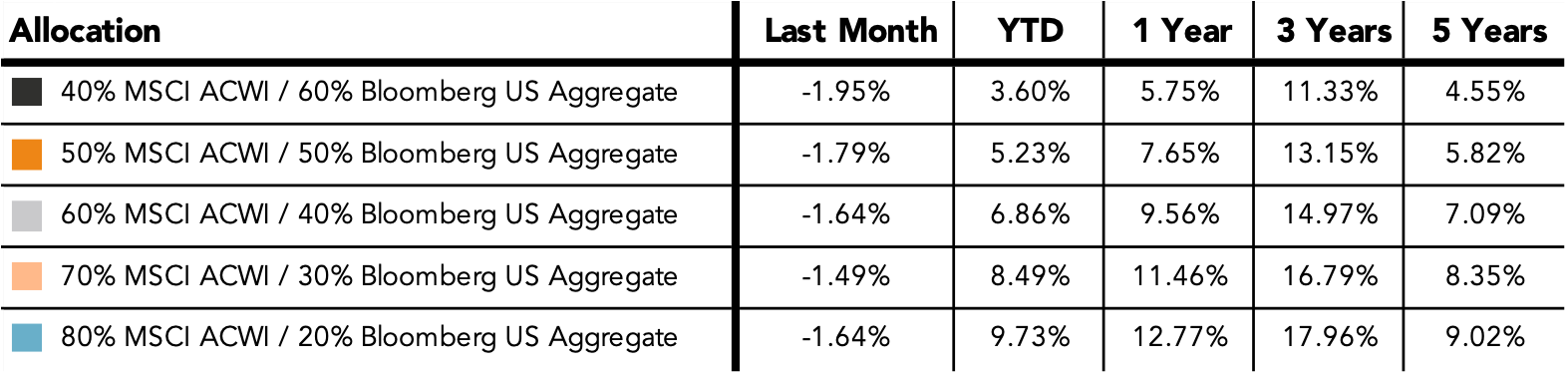
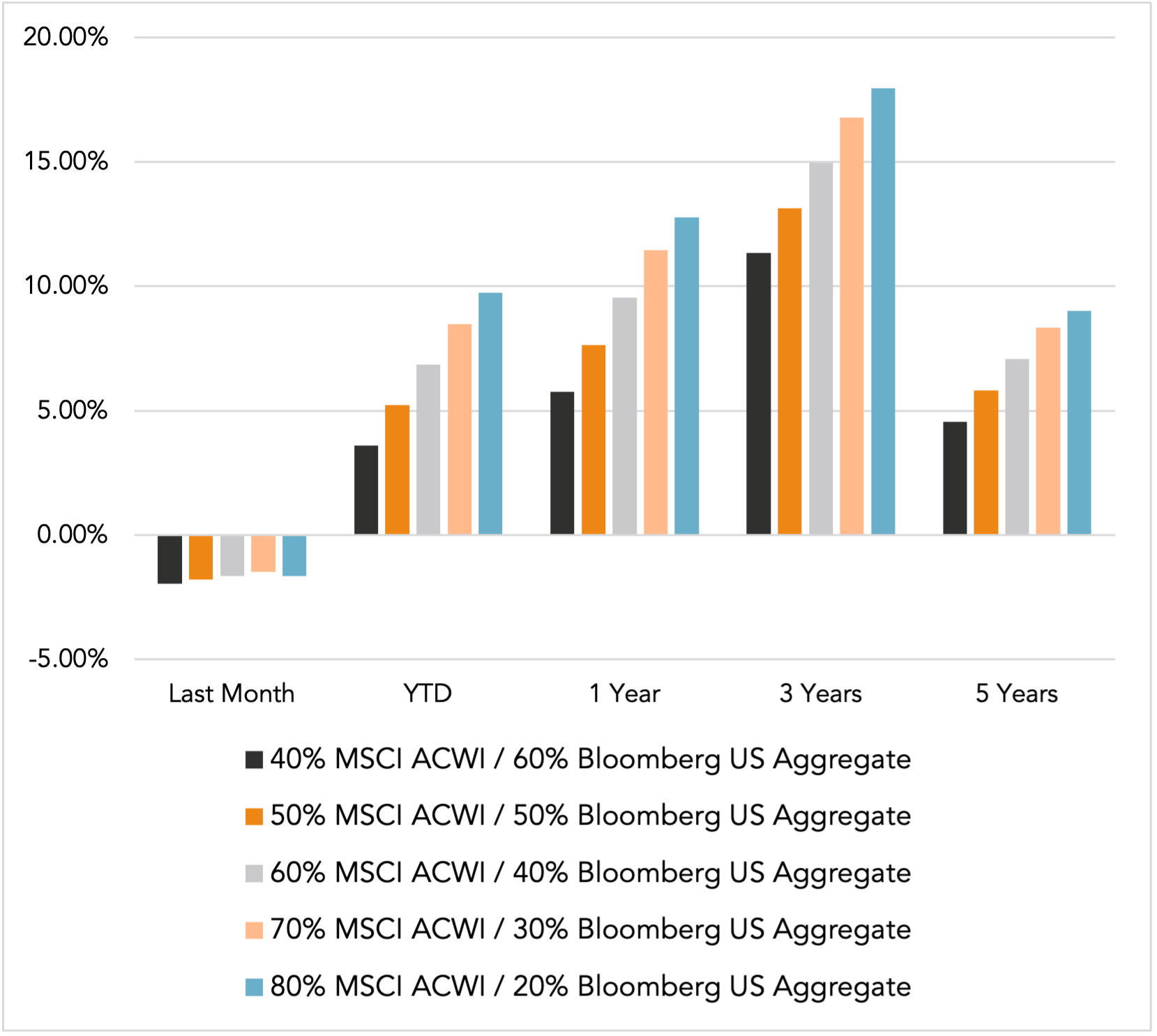
Indexes are unmanaged and cannot be directly invested into. Past performance is no indication of future results. Investing involves risk and the potential to lose principal.
The Russell 3000 Index is a United States market index that tracks the 3000 largest companies. MSCI Emerging Markets Index is a broad market cap-weighted Index showing the performance of equities across 23 emerging market countries defined as emerging markets by MSCI. MSCI ACWI ex-U.S. Index is a free-float adjusted market capitalization-weighted index that is designed to measure the equity market performance of developed and emerging markets excluding companies based in the United States. Bloomberg U.S. Aggregate Bond Index represents the investment-grade, U.S. dollar-denominated, fixed-rate taxable bond market, including Treasuries, government-related and corporate securities, as well as mortgage and asset-backed securities. Bloomberg Municipal Index is the US Municipal Index that covers the US dollar-denominated long-term tax-exempt bond market. The index has four main sectors: state and local general obligation bonds, revenue bonds, insured bonds, and prerefunded bonds.


Monthly Market Update – August 2026